What Is a Hysteresis Loop in Ferroelectric Materials?
A Ferroelectric Material is characterized by its ability to maintain a spontaneous electric polarization even after the external electric field is removed. When an alternating electric field is applied to such a material, the polarization does not change instantaneously or linearly with the field. Instead, it follows a delayed path, forming a closed loop known as the Hysteresis Loop.
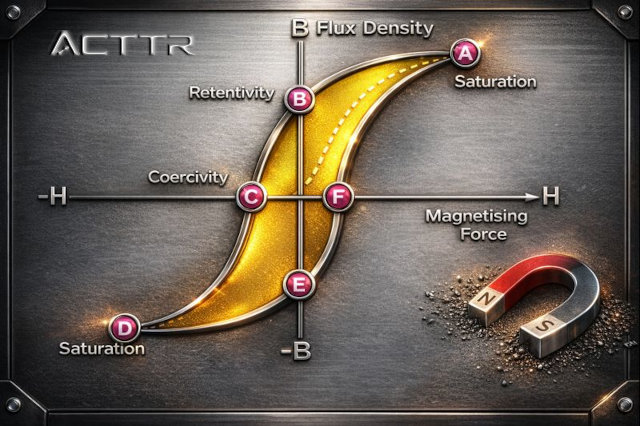
Hysteresis Loop
This loop reflects the internal domain switching process, energy barriers, and dipole alignment within the material. Unlike linear dielectrics, ferroelectric materials exhibit memory effects, making the hysteresis loop a direct indicator of data storage capability.
Fundamental Parameters of the Hysteresis Loop
Remanent Polarization (Pr)
Remanent Polarization refers to the remaining polarization when the applied electric field returns to zero. This parameter directly represents how well a ferroelectric material can retain stored information.
-
High Remanent Polarization → Strong signal margin and stable memory states
-
Low Remanent Polarization → Increased risk of data loss and read errors
For ferroelectric random-access memory (FeRAM), a sufficiently high Pr is essential for reliable read/write operations.
Coercive Field (Ec)
The Coercive Field is the magnitude of electric field required to reverse the polarization direction. It determines:
-
Required operating voltage
-
Switching speed
-
Power consumption
An optimal Ec balances low-power operation with resistance to noise and thermal disturbances.
ACTTR Technology brought to you the most advanced Ferroelectric Analyzer, which integrated related test options, with fully automatice measurement capabilities. It helps you in your new material research works with efficiency. Please Contact ACTTR immediately. We're pleased to serve you!